| This site is designed by |
Scroll Down for New Books NEWS
August 2004: Timur Kuran has written a fascinating paper on Why the Middle East is economically underdeveloped. Anyone interested in social evolution will find this timely paper worth reading. Download Paper.
July 2004: Geoffrey Hodgson has published a new book, The Evolution of Institutional Economics: Agency, Structure and Darwinism in American Institutionalism.
June 2004: A Workshop on Adaptation vs. Selection in Industrial Change will take place at the Academy of Management Meeting in New Orleans, August 7, 2004.
 | |
| November 2003: Johann Peter Murmann's book on the coevolution of firms, technology, and national institutions has just been published. You can read reviews and download the first chapter of Knowledge and Competitive Advantage from the author's website. |
October 2003: The abstracts of a new working papers on industrial evolution by Giovanni Gavetti and Johann Peter Murmann are posted.
April 2003: PBS has produced a spectacular film showing how recent advances in genetic analyses are rewriting the history of human beings. See the PBS website for a schedule of The Journey of Man. The film is also available on video, and Princeton University Press has published a compendium book: The Journey of Man: A Genetic Odyssey.
 | February 2003: Robert Aunger has published a new book in which he spells out his theory of memes. You can read the introduction and the first chapter of his "Electric Meme" here. |
November 2002: Following in the tradition of Karl Popper and David Hull, Marion Blute has written a very interesting paper on the development of science as an evolutionary process. You can read the article The Evolutionary Ecology of Science online at the Journal of Memetics.
February 2002: Jack Vromen reviews Jason Pott’s The New Evolutionary Microeconomics: Complexity, Competence and Adaptive Behaviour in the Journal of Memetics.
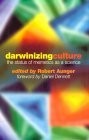 | January 2002: Howard E. Aldrich reviews Darwinizing Culture: The Status of Memetics as Science, a new book about the meme concept edited by Robert Aunger. Aunger brought together both supporters and opponents of meme theory (Susan Blackmore, Maurice Bloch, Robert Boyd, Rosaria Conte, David L Hull, Adam Kuper, Kevin Leland, John Odling-Smee, Henry Plotkin, Peter J. Richerson, Dan Sperber) to debate the validity of a concept regarded by many as scientifically suspect. Click here for a table of contents. Share your thoughts on the book or the review by posting a message in the discussion forum. |
Aldrich Review Aunger's Response
December 2001: A volume "Evolution of Cultural Entities" edited by Wheeler, Ziman and Boden is in preparation. Click here for a tentative table of contents and e-mail addresses of editors.
August 2001: We created a link to Robert Axelrod’s course syllabus Complexity Theory in the Social Sciences.
July 2001: Just discovered links to selected writings of David Hume and Adam Smith.
June 2001: Comparing Evolutionary Dynamics Across Different National Settings. You can read the abstract and download this new paper on the early development of the synthetic dye industry by Johann Peter Murmann and Ernst Homburg here.
May 2001: Evolutionary Theory in Management and Organization Theory at the Beginning of a New Millennium: A Symposium on the State of the Art and Opportunities for Future Research in Evolutionary Theory. You can now read a transcript of the symposium that took place on Aug 7 2000, in Toronto, Canada. The symposium was organized by Johann Peter Murmann, and the speakers were Howard Aldrich, Dan Levinthal and Sid Winter. Click here for conference details.
|
| May 2001: Evolutionary Theories in the Social Sciences (etss.net) has asked Brian Loasby to read Technological Innovation as an Evolutionary Process, edited by John Ziman, and offer his reflections on this exiting new volume. It is widely known that Darwin was highly influenced by the economist Thomas Malthus in developing the ideas of natural selection. But it comes as a surprise to many scholars in evolutionary theory that Adam Smith’s writings also had a significant influence on Darwin’s thought. Loasby has published extensively (for a publication list click here) on the history of economic thought and recently won the Schumpeter Prize for his 1999 book Knowledge, Institutions and Evolution in Economics. In the present essay, Loasby engages such important economists as Adam Smith, Alfred Marshall, Allyn Young, Frank Knight, Joseph Schumpeter, and Friedrich Hayek in a dialogue with the authors of this volume. While not denying the usefulness of comparing technological innovation to biological processes, Loasby sees technological innovation as a special case of human activity that leads to the growth of knowledge. Loasby highlights that such knowledge creation processes have elements that are clearly different from biological processes. Variation and selection processes, for instance, are much more intimately related in human activity than in biology. These conclusions bring Loasby to a position that is quite congenial to the concerns of Donald Campbell, David Hull, or Richard Nelson and Sidney Winter—all of whom emphasized that biological evolution is just a special case of a general selection process. Because Loasby lives in Great Britain, I decided that it would be appropriate to keep his British English in the text.
|

Loasby's Essay Pavitt's Review
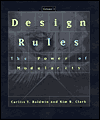 | Design Rules, Vol.1: The Power of Modularity by Carliss Baldwin and Kim Clark From the Publisher: We live in a dynamic economic and commercial world, surrounded by objects of remarkable complexity and power. In many industries, changes in products and technologies have brought with them new kinds of firms and forms of organization. We are discovering news ways of structuring work, of bringing buyers and sellers together, and of creating and using market information. Although our fast-moving economy often seems to be outside of our influence or control, human beings create the things that create the market forces. Devices, software programs, production processes, contracts, firms, and markets are all the fruit of purposeful action: they are designed. Using the computer industry as an example, Carliss Y. Baldwin and Kim B. Clark develop a powerful theory of design and industrial evolution. They argue that the industry has experienced previously unimaginable levels of innovation and growth because it embraced the concept of modularity, building complex products from smaller subsystems that can be designed independently yet function together as a whole. Modularity freed designers to experiment with different approaches, as long as they obeyed the established design rules. Drawing upon the literatures of industrial organization, real options, and computer architecture, the authors provide insight into the forces of change that drive today's economy. |
 | An Evolutionary Approach to Social Welfare by Christian Satorius From the Publisher: A person finds a lost purse with a lot of money in it. Ought she try to return it to its owner or keep it herself? And even more interestingly, what will she actually do? According to standard economic theory, a rational person is supposed to maximize her utility and, at least when unobserved, keep the purse for herself. In reality, however, most people return the purse although they are unobserved or, at least, they feel uneasy about not doing so. Evidently, these people share a common attitude towards other people's property. In social life, norms and values like this typically help in settling potential conflicts of interest to the mutual benefit of all. While not evident immediately, social norms and values also play a crucial role in the theory of social choice. In the first half of the 20th century, the special acknowledgement by economic theory of the autonomy of individuals and their subjective view of the world had led to the serious problem that socially acceptable decisions could not be made in the absence of unanimity. In this work, social norms and values are reintroduced to overcome this shortcoming by applying a common standard and, thus, making individual preferences comparable. In particular, it is shown, how the adoption of these standards is part of every individual's social development, how the standards themselves arose in the course of social evolution and how human beings were endowed with the necessary learning mechanism by Darwinian evolution in the first place. |
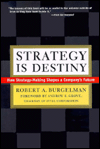 | Strategy is Destiny: How Strategy-Making Shapes a Company's Future by Robert A. Burgelman with a Foreword by Andrew S. Grove From the Publisher: This sophisticated book, written for executives at established companies and business school scholars, places two mutually antagonistic concepts -- strategy (which posits an open-ended, yet-to-be-determined future) and destiny (the belief in an inevitable end) -- into a relationship. Author Robert Burgelman, a professor at Stanford University, begins with look at strategy -- what it is, how it evolves, becoming inertial and destinal or adaptive and transformative -- using Intel as a model. He then proceeds with an advanced discussion of strategy that is fascinating, challenging, and well worth reading; although this book isn't right for the casual reader, it is certain to be appreciated by its intended audience. |
 | Unto Others: The Evolution & Psychology of Unselfish Behavior by Elliot Sober & David Sloan Wilson In Unto Others, philosopher Elliott Sober and biologist David Sloan Wilson bravely attempt to reconcile altruism, both evolutionary and psychological, with the scientific discoveries that seem to portray nature as red in tooth and claw. The first half of the book deals with the evolutionary objection to altruism. For altruistic behavior to be produced by natural selection, it must be possible for natural selection to act on groups--but conventional wisdom holds that group selection was conclusively debunked by George Williams in Adaptation and Natural Selection. Sober and Wilson nevertheless defend group selection, instructively reviewing the arguments against it and citing important work that relies on it. They then discuss group selection in human evolution, testing their conclusions against the anthropological literature. |
 | Evolutionary Innovations: The Business of Biotechnology by Maureen D. McKelvey This book examines the initial commercial uses of genetic engineering. Genetic engineering is one of the most modern, controversial and dynamic of the science based technologies. It is not an object but a set of techniques or way of doing things. The development of these techniques from the 1970s onwards illustrates the changing relationships between universities and firms and between basic science and research oriented towards commercial uses. The main focus of the book is on two firms - Genentech in the United States and Kabi in Sweden and their activities and 'knowledge-seeking' behavior in the development of human growth hormone and how those ran in parallel with university science. As well as providing a remarkably clear account of these developments (the book includes a chapter on the basics of biotechnology for the lay person), McKelvey also provides a fresh contribution to our understanding of innovation processes by using the evolutionary metaphor to interpret patterns of change where novelty, transmission, and selection are important elements, and where the knowledge-seeking behavior of firms and other agents are critical for survival and development. The book will be of considerable interest to a wide audience concerned to understand the complexities of innovation processes in the 'knowledge society' - management and organization researchers, economists, policy advisers, managers and strategies responsible for turning knowledge into product and profit. |
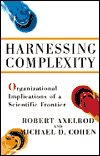 | From Publisher's Weekly - Publishers Weekly In a world where companies are forced to adapt to an ever more quickly changing marketplace, where people from diverse backgrounds must work together in order to solve problems rapidly and the future is hard to predict, wouldn't it be wonderful if all this complexity could work to your advantage? Axelrod (The Evolution of the Corporation) and Cohen (a consultant to the Xerox Palo Alto Research Center), both professors at the University of Michigan, aim to draw on the principles of evolutionary biology, computer science and social design to explain the functioning of "complex adaptive systems" (specifically businesses), and how to improve them. They explore such abstract issues as whether to encourage variation in a rapidly changing situation (whether it refers to a diversity of products or problem-solving approaches, variety is defined as "the raw material for adaptation"); the impact of manipulating interactions (with respect to time as well as both physical and conceptual space) in an organization; and how to select and support the most viable individuals, teams, systems or business strategies that emerge. |
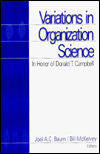 | Variations in Organization Science: In Honor of Donald T. Campbell If you are interested in evolutionary theories of organizations, this is a new collection of essays that you want to take a look at. Click on the cover for a table of contents. |
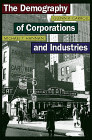 | The Demography of Corporations and Industries by Glenn R. Carroll and Michael T. Hannan Coming soon: A full review and more of the organizational ecology literature and research (500 pp). The publisher's preview: The Demography of Corporations and Industries is the first book to present the demographic approach to organizational studies in its entirety. It examines the theory, models, methods, and data used in corporate demographic research. Carroll and Hannan explore the processes by which corporate populations change over time, including organizational founding, growth, decline, structural transformation, and mortality. They review and synthesize the major theoretical mechanisms of corporate demography, ranging from aging and size dependence to population segregation and density dependence. The book also explores some selected implications of corporate demography for public policy, including employment and regulation. Click on the title for a table of contents. Read Boyan Jovanovic’s Review in the JEL.
|
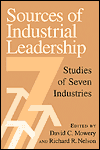 | Sources of Industrial Leadership: Studies of Seven Industries. Edited by David Mowery and Richard R. Nelson This book describes and analyzes how seven major high-tech industries evolved in the USA, Japan, and Western Europe. The industries covered are machine tools, organic chemical products, pharmaceuticals, medical devices, computers, semiconductors, and software. In each of these industries, firms located in one or a very few countries became the clear technological and commercial leaders. In number of cases, the locus of leadership changed, sometimes more than once, over the course of the histories studied. The locus of the book is on the key factors that supported the emergence of national leadership in each industry, and the reasons behind the shifts when they occurred. Special attention is given to the national policies which helped to create, or sustain, industrial leadership. Click on the title for a table of contents. Read Paul L. Robertson's Review on eh.net. |
Editor
Advisory Board
Howard Aldrich (North Carolina)
Glenn Carroll (Stanford)
Giovanni Dosi (Pisa)
David Hull (Northwestern)
Steven Klepper (Carnegie Mellon)
Richard Nelson (Columbia)
Charles Tilly (Columbia)
Michael Tushman (Harvard)
Walter Vincenti (Stanford)